No products in the cart.



In the world of nutrition, skincare, and biology, you constantly hear terms like amino acids, peptides, and proteins. While they are all fundamentally linked, they each play a distinct role in your body’s health and function.
Understanding the difference between these three compounds is key to making informed choices about your diet, supplements, and cosmetic products.
Let’s break down these essential biological components.
Think of amino acids as the individual LEGO bricks. They are the smallest, foundational units in this biological hierarchy.
Amino acids are organic compounds that contain both amine () and carboxyl () functional groups.
Structure: Single, independent molecules.
Function: They are the raw material used to build peptides and proteins. They also play roles in energy production, hormone synthesis, and neurotransmitter function.
Types: There are 20 standard amino acids.
Essential: Nine amino acids the body cannot produce and must be obtained through diet (e.g., Leucine, Lysine).
Non-Essential: Those the body can synthesize on its own.
Key Takeaway: Amino acids are the monomers (single units) that combine to form larger chains.
Peptides are what you get when a few amino acids link together. They are the small, manageable bracelets made of LEGO bricks.
Peptides are formed when two or more amino acids are joined by a peptide bond. This short chain is small enough to often be easily absorbed by the body, allowing them to act as powerful signaling molecules.
Structure: Short chains, typically 2 to 50 amino acids long.
Dipeptide: Two amino acids.
Tripeptide: Three amino acids.
Polypeptide: A longer chain, often used interchangeably with small proteins, but still generally under 50 units.
Function: Their main role is to act as biological messengers. They signal cells to perform specific actions, such as initiating collagen production, regulating appetite, or controlling inflammation.
Examples: Copper Peptides (in skincare for healing) and Insulin (a hormonal peptide/small protein).
Key Takeaway: Peptides are short chains of amino acids that serve a specific, targeted communication function.
Proteins are the result of many peptides folding together into highly complex, three-dimensional structures. They are the large, intricate LEGO castle built from countless bricks.
Proteins are the workhorses of the cell, essential for structure, function, and regulation of the body’s tissues and organs.
Structure: Long, complex chains, typically 50 or more amino acids long, which fold into unique, specific shapes.
Function: Proteins have vast, macroscopic roles:
Structural: Forming tissues (e.g., Collagen and Elastin in skin).
Enzymatic: Speeding up chemical reactions (e.g., Lactase).
Movement: Enabling muscle contraction (e.g., Actin and Myosin).
Transport: Carrying substances (e.g., Hemoglobin carrying oxygen).
Examples: Keratin (in hair and nails), Antibodies (in the immune system), and Enzymes.
Key Takeaway: Proteins are long, folded chains of amino acids that perform the major structural and functional tasks in the body.
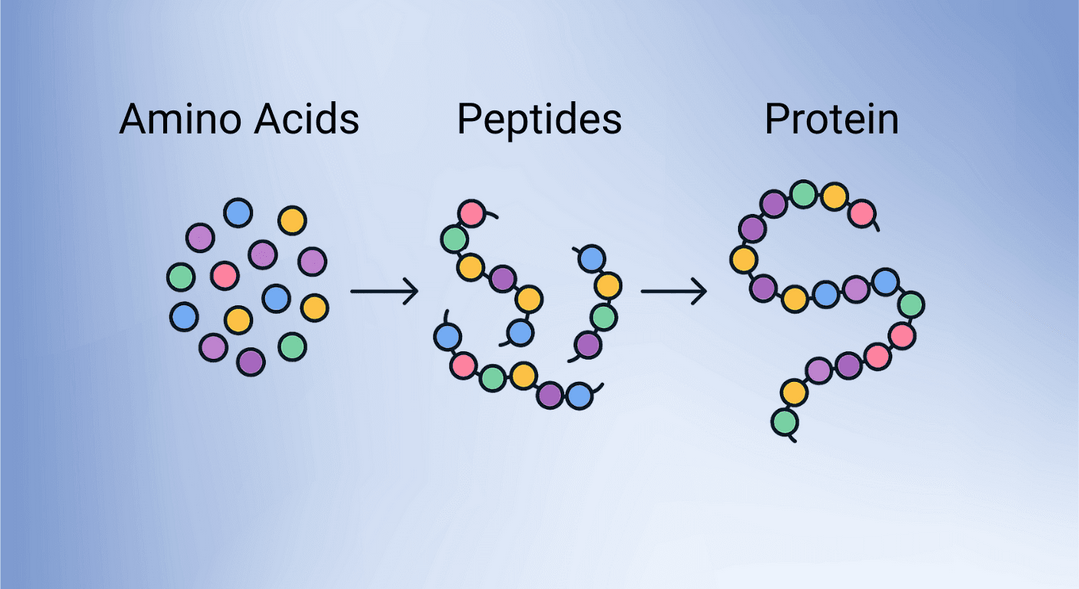
To put it all into perspective, here is a quick reference guide to the key distinctions: